
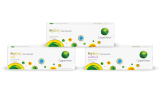

MiSight® 1 day

One-day, soft contact lens for children that’s proven to slow the worsening of myopia*1

Replacement Schedule

  • Daily Replacement

Corrects

  • Myopia (short-sightedness)

MiSight® 1 day

MiSight® 1 day contact lenses with ActivControl® Technology are designed to slow the worsening of your child’s myopia, helping them to see clearly and enjoy an active lifestyle.†2-5

Myopia (often called nearsightedness or shortsightedness) is more than just blurry vision – it's a progressive, irreversible disease that typically worsens as a child grows. Myopia affects nearly 1 in 3 children worldwide, and if left uncorrected, it can impact a child’s learning, academic performance, athletics, and daily activities.‡7-13

As a child’s myopia worsens, it increases their risk of sight-threatening eye health conditions later in life, including retinal detachment, myopic maculopathy, glaucoma, and cataracts.14-17

Features and Benefits

  • Tested and proven to reduce the worsening of your child’s myopia by half§◊1,18
  • Effective for nearly all children with myopia◊18
  • Works at any age treatment starts¶1
  • Preferred by children over spectacles19
  • Child-friendly and easy to use3
  • Contact lenses can help improve your child’s self-perception of their appearance, athletic competence, and social acceptance4

Unsure which products are best for you?

Take this four question quiz to discover which of our products may best fit your needs.

Find Your Lens

Packaging images for illustration purposes only.

Plastic used in participating CooperVision soft contact lens products is determined by the weight of plastic in the blister, the lens, and the secondary package, including laminates, adhesives, and auxiliary inputs (e.g. ink). The determination does not include plastic used during the manufacturing process for both these products and their packaging.20

For the device safety, warnings, precaution, and local regulatory information, please refer to the Instruction for Use leaflet.

* Using measured and modeled data, pooled across ages (8-17), MiSight® 1 day slowed myopia progression by an average of approximately 50%.
† In clinical study, mean weekday wear time increased from 12.8 hours/day at 6-months to 13.9 hours/day at 6-years with a mean of >6.5 days/week
‡ Based on a comprehensive analysis of 276 studies, involving a total of 5,410,945 children and adolescents with spherical equivalent of -0.50D or less, aged 6-19 from across 50 countries, with notable variations in prevalence across different demographic groups.
§ Using measured and modeled data, pooled across ages (8-17), MiSight® 1 day slowed myopia progression by an average of approximately 50%.
◊ 90% of myopic eyes respond to MiSight® 1 day treatment; ages 11-15 at initiation of treatment, n=90
¶ Children with myopia fit with MiSight® 1 day contact lenses ages 8-15 continued to experience slowed myopia progression as long as they remained in treatment.

References:
1. Arumugam B et al. Modelling Age Effects of Myopia Progression for the MiSight 1 day Clinical Trial. IOVS. 2021;62(8):2333.
2. CVI data on file 2025.
3. Chamberlain P, et al. A 3-year randomised clinical trial of MiSight® lenses for myopia control. OVS 2019; 96(8):556-567.
4. Walline J, et al. Randomized trial of the effect of contact lens wear on self-perception in children. Optom Vis Sci. 2009 Mar;86(3):222-32.
5. Woods J et al. Ocular health of children wearing daily disposable contact lenses over a 6-year period. CLAE 2021 Aug;44(4):101391.
6. K. Zadnik, G.L. Mitchell, L.A. Jones, D.O. Mutti; Factors Associated with Rapid Myopia Progression in School-aged Children . Invest. Ophthalmol. Vis. Sci. 2004;45(13):2306.
7. Liang J, Pu Y, Chen J, et al, Global prevalence, trend and projection of myopia in children and adolescents from 1990 to 2050: a comprehensive systematic review and meta-analysis, British Journal of Ophthalmology, Published Online First: 24 September 2024.
8. Ma X, Zhou Z, Yi H, Pang X, Shi Y, Chen Q, Meltzer ME, le Cessie S, He M, Rozelle S, Liu Y, Congdon N. Effect of providing free glasses on children's educational outcomes in China: cluster randomized controlled trial. BMJ. 2014 Sep 23;349:g5740.
9. Jan C, Li S, Kang M, et al. Association of visual acuity with educational outcomes: a prospective cohort study. British Journal of Ophthalmology 2019;103:1666-1671.
10. Yadav R, et al. Vision Related Quality of Life, Sports Activities and Academic Performance Among Myopic School Going children: A Cross Sectional Study. African Journal of Biomedical Research 2024; 27(1S), 2228-2231.
11. Sankaridurg P, Tahhan N, Kandel H, et al. IMI Impact of myopia. Invest Ophthalmol Vis Sci. 2021;62(5):2. pg 6.
12. Shams N, Mobaraki H, Kamali M, Jafarzadehpour E. Comparison of quality of life between myopic patients with spectacles and contact lenses, and patients who have undergone refractive surgery. J Curr Ophthalmol. 2015 Nov 17;27(1-2):32-6.
13. Pan C-W, Ramamurthy D & Saw S-M. Worldwide prevalence and risk factors for myopia. Ophthalmic Physiol Opt 2012, 32, 3-16.
14. Xu L et al. High myopia and glaucoma susceptibility, the Beijing Eye Study. Ophthalmology. 2007;114(2):216-20.
15. Flitcroft DI. The complex interactions of retinal, optical and environmental factors in myopia aetiology. PRER 2013;31(6):622-60.
16. Younan C, et al. Myopia and incident cataract and cataract surgery: the blue mountains eye study. IVOS 2002;43(12):3625-3632.
17. Chen SJ, et al. Prevalence and associated risk factors of myopic maculopathy in elderly Chinese: the Shihpai eye study. IOVS 2012;53(8):4868-73.
18. Chamberlain P, et al. Long-term Effect of Dual-focus Contact Lenses on Myopia Progression in Children: A 6-year Multicenter Clinical Trial. OVS 2022 Mar 1;99(3):204-212.
19. Lumb E, et al. Six years of wearer experience in children participating in a myopia control study of MiSight® 1 day. CLAE 2023; 46(4): 101849.
20. CVI data on file, 2024.

SA14190 / APP145577